
Building Academic Vocabulary and Deep
Comprehension, Grades 6-12
Course Description
 |
The course examines high-leverage practices for building academic vocabulary in 6-12 students.
Educators will examine strategies to help students learn content-specific academic vocabulary, such as visualizing and drawing words, using games, exploring word connections with interactive word walls, using book choice, collaborative reading groups, and more, to help secondary students expand their vocabulary in engaging and meaningful ways. |
Educators will also help students learn word parts, such as morphology, syntax, and root word analysis. These skills can help students navigate complex, grade-level texts with confidence and accuracy by helping them connect words with their meanings.
A central focus of the course is supporting linguistically diverse students by recognizing and leveraging their linguistic assets while addressing their unique language development needs with scaffolds and supports. Educators will explore research-based strategies such as actively using and studying words, creating engaging questions, and responding to text-dependent questions to deepen reading comprehension, enhance vocabulary acquisition, promote reading fluency, and strengthen oral language development.
Throughout the course, educators will engage in structured reflection on their classroom practice and develop a concrete plan to integrate effective vocabulary and comprehension instruction into daily instruction. By the end of this course, educators will possess a toolkit of practical, evidence-based methods to expand student word knowledge, ensuring that all learners—regardless of their starting point—can achieve higher levels of fluency, vocabulary knowledge, and stronger comprehension in the content areas and strengthen students’ language development and reading comprehension in intentional, research-based ways.
Essential Questions
- What evidence-based instructional strategies best support the acquisition of academic vocabulary and reading comprehension skills?
- What is the relationship between vocabulary and reading comprehension?
- What are efficient and effective ways to build language skills in multilingual learners?
- How does instruction in content area vocabulary build discipline-specific knowledge?
Course Modules
|
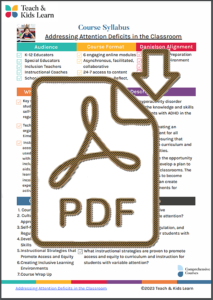
| Course Syllabus
|
|

Comments from Teachers
“I really like the sketch note-taking and using tiers to prioritize vocabulary instruction. I’ll use morphology in my instruction systematically and explicitly. I’ll also use the wide variety of strategies I’ve learned to practice and reinforce vocabulary after it is introduced.”
“This course taught me about the importance of having culturally relevant texts in my instruction. It also taught me how to implement vocabulary strategies for linguistically diverse students.”
“I like how I can access the information at my own speed and when the time is best for my schedule. Sometimes it can feel overwhelming to have to complete PD during a busy work week and with the busy schedules of my own children. I am a return customer, and plan to return to TKL for future PDs.”
“My overall experience has been very positive. The coursework is interesting and not repetitive. Feedback is timely and helpful. The discussion boards give me a sense of connection with other educators who have completed the course.”
Danielson Teacher Framework Course Alignment